18th century
XVIIIe siècle : Le XVIIIe siècle (ou 18e siècle) commence le 1er janvier 1701 et finit le 31 décembre 1800.
Il s’étend entre les jours juliens 2 342 337,5 et 2 378 861,5.
En France, les historiens considèrent qu’il commence en 1715 avec la mort de Louis XIV et se termine en 1815 avec la chute de Napoléon Ier et le congrès de Vienne.
Au Royaume-Uni, l’historiographie fait courir le « long dix-huitième siècle (en) » de la Glorieuse Révolution de 1688 à 1815.
Au XVIIIe siècle, les Lumières est un terme qui désigne un mouvement culturel et philosophique ayant dominé en Europe, et plus particulièrement en France. Elles donnèrent par extension à cette période le nom de siècle des Lumières (en Allemagne : Zeitalter der Aufklärung, en Angleterre et aux États-Unis : Age of Enlightenment) qui conduisent à l’avènement de la démocratie, en Angleterre et aux États-Unis avec la guerre d’indépendance américaine[pas clair], et en France avec la Révolution française. Les Pays-Bas autrichiens et la principauté de Liège connaissent aussi des mouvements insurrectionnels avec notamment la révolution brabançonne et la révolution liégeoise.
Le XVIIIe siècle voit l’apogée de l’institution esclavagiste. La traite négrière culmine. Ce commerce triangulaire a lieu entre l’Europe (pacotilles, tissus, verroteries, armes à feu, etc.), l’Afrique occidentale et équatoriale (esclaves) et les Antilles et les Amériques (produits agricoles : coton, thé…). Six à sept millions d’esclaves noirs sont déportés par les Européens vers l’Amérique au XVIIIe siècle. Ils achètent leurs esclaves à des chefs et souverains locaux, qui razzient les tribus voisines et échangent leurs prisonniers sur le littoral contre des produits fabriqués en Europe. De nombreuses tribus disparaissent. D’autres se regroupent pour constituer des États qui deviennent à leur tour marchands d’esclaves. XVIIIe siècle sur Wikipédia (fr) – 18th century : The 18th century lasted from 1 January 1701 (represented by the Roman numerals MDCCI) to 31 December 1800 (MDCCC). During the 18th century, elements of Enlightenment thinking culminated in the Atlantic Revolutions. Revolutions began to challenge the legitimacy of monarchical and aristocratic power structures. The Industrial Revolution began mid-century, leading to radical changes in human society and the environment. The European colonization of the Americas and other parts of the world intensified and associated mass migrations of people grew in size as part of the Age of Sail. During the century, slave trading expanded across the shores of the Atlantic Ocean, while declining in Russia and China.
Western historians have occasionally defined the 18th century otherwise for the purposes of their work. For example, the « short » 18th century may be defined as 1715–1789, denoting the period of time between the death of Louis XIV of France and the start of the French Revolution, with an emphasis on directly interconnected events. To historians who expand the century to include larger historical movements, the « long » 18th century may run from the Glorious Revolution of 1688 to the Battle of Waterloo in 1815 or even later. France was the sole world superpower from 1659, after it defeated Spain, until 1815, when it was defeated by Britain and its coalitions following the Napoleonic Wars.
In Europe, philosophers ushered in the Age of Enlightenment. This period coincided with the French Revolution of 1789, and was later compromised by the excesses of the Reign of Terror. At first, many monarchies of Europe embraced Enlightenment ideals, but in the wake of the French Revolution they feared loss of power and formed broad coalitions to oppose the French Republic in the French Revolutionary Wars. Various conflicts throughout the century, including the War of the Spanish Succession and the Seven Years’ War, saw Great Britain triumph over its rivals to become the preeminent power in Europe. However, Britain’s attempts to exert its authority over the Thirteen Colonies became a catalyst for the American Revolution. The 18th century also marked the end of the Polish–Lithuanian Commonwealth as an independent state. Its semi-democratic government system was not robust enough to prevent partition by the neighboring states of Austria, Prussia, and Russia.
In West Asia, Nader Shah led Persia in successful military campaigns. The Ottoman Empire experienced a period of peace, taking no part in European wars from 1740 to 1768. As a result, the empire was not exposed to Europe’s military improvements during the Seven Years’ War. The Ottoman military consequently lagged behind and suffered several defeats against Russia in the second half of the century.
In South Asia, the death of Mughal emperor Aurangzeb was followed by the expansion of the Maratha Confederacy and an increasing level of European influence and control in the region. In 1739, Persian emperor Nader Shah invaded and plundered Delhi, the capital of the Mughal Empire. Later, his general Ahmad Shah Durrani scored another victory against the Marathas, the then dominant power in India, in the Third Battle of Panipat in 1761. By the middle of the century, the British East India Company began to conquer eastern India, and by the end of the century, the Anglo-Mysore Wars against Tipu Sultan and his father Hyder Ali, led to Company rule over the south.
In East Asia, the century was marked by the High Qing era, a period characterized by significant cultural and territorial expansion. This period also experienced relative peace and prosperity, allowing for societal growth, increasing literacy rates, flourishing trade, and consolidating imperial power across the vast Qing dynasty’s territories. Conversely, the continual seclusion policy of the Tokugawa shogunate also brought a peaceful era called Pax Tokugawa and experienced a flourishment of the arts as well as scientific knowledge and advancements, which were introduced to Japan through the Dutch port of Nagasaki. In Southeast Asia, the Konbaung–Ayutthaya Wars and the Tây Sơn Wars broke out while the Dutch East India Company established increasing levels of control over the Mataram Sultanate.
In Africa, the Ethiopian Empire underwent the Zemene Mesafint, a period when the country was ruled by a class of regional noblemen and the emperor was merely a figurehead. The Atlantic slave trade also saw the continued involvement of states such as the Oyo Empire. In Oceania, the European colonization of Australia and New Zealand began during the late half of the century. In the Americas, the United States declared its independence from Great Britain. In 1776, Thomas Jefferson wrote the Declaration of Independence. In 1789, George Washington was inaugurated as the first president. Benjamin Franklin traveled to Europe where he was hailed as an inventor. Examples of his inventions include the lightning rod and bifocal glasses. Túpac Amaru II led an uprising that sought to end Spanish colonial rule in Peru. 18th century sur Wikipédia (en)
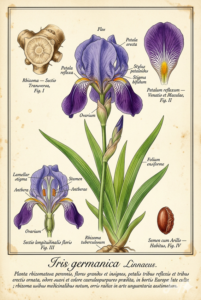
Planche naturaliste d’Iris germanica sur vélin jauni — sujet principal en pleine floraison, pétales violets veinés rendus à l’aquarelle Redouté, entouré de quatre vignettes de coupes et détails annotées en latin.
A naturalist plate of Iris germanica on aged vellum — main subject in full bloom, violet veined petals rendered in Redouté watercolour, surrounded by four vignettes of cross-sections and details annotated in Latin.
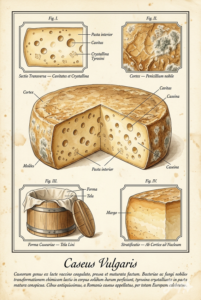
Une meule de fromage affiné en coupe centrale sur vélin crème, entourée de quatre vignettes : section transversale avec œils et cristaux de tyrosine, détail de la croûte et du Penicillium, le moule en bois cerclé de toile de lin, stratification croûte-à-cœur en lavis sépia.
A wheel of aged cheese in central cross-section on cream vellum, surrounded by four vignettes: internal structure with eyes and tyrosine crystals, rind detail with Penicillium, the wooden mould lined with linen cloth, crust-to-core stratification in sepia wash.