engraving
Engraving : Engraving is the practice of incising a design on a hard, usually flat surface by cutting grooves into it with a burin. The result may be a decorated object in itself, as when silver, gold, steel, or glass are engraved, or may provide an intaglio printing plate, of copper or another metal, for printing images on paper as prints or illustrations; these images are also called « engravings ». Engraving is one of the oldest and most important techniques in printmaking. Wood engravings, a form of relief printing and stone engravings, such as petroglyphs, are not covered in this article.
Engraving was a historically important method of producing images on paper in artistic printmaking, in mapmaking, and also for commercial reproductions and illustrations for books and magazines. It has long been replaced by various photographic processes in its commercial applications and, partly because of the difficulty of learning the technique, is much less common in printmaking, where it has been largely replaced by etching and other techniques.
« Engraving » is loosely but incorrectly used for any old black and white print; it requires a degree of expertise to distinguish engravings from prints using other techniques such as etching in particular, but also mezzotint and other techniques. Many old master prints also combine techniques on the same plate, further confusing matters. Line engraving and steel engraving cover use for reproductive prints, illustrations in books and magazines, and similar uses, mostly in the 19th century, and often not actually using engraving. Traditional engraving, by burin or with the use of machines, continues to be practised by goldsmiths, glass engravers, gunsmiths and others, while modern industrial techniques such as photoengraving and laser engraving have many important applications. Engraved gems were an important art in the ancient world, revived at the Renaissance, although the term traditionally covers relief as well as intaglio carvings, and is essentially a branch of sculpture rather than engraving, as drills were the usual tools. Engraving sur Wikipédia (en)
Gravure : Le terme de gravure désigne l’ensemble des techniques artistiques, artisanales ou industrielles qui utilisent l’incision ou le creusement pour produire une image, un texte ou toute autre inscription dans la matière.
Cet art graphique consiste à inciser ou à creuser à l’aide d’un outil ou d’un mordant une matrice. Après encrage, celle-ci est imprimée sur du papier ou sur un autre support. L’œuvre finale ainsi obtenue s’appelle une estampe. Par abus de langage, « gravure », « estampe » et « tirage » sont souvent confondus.
Le terme « estampe » est utilisé pour désigner l’œuvre résultant d’un procédé de gravure. Le tirage papier est généralement multiple.
Le terme « illustration » est utilisé quand la gravure sert à mettre en valeur un texte (le tirage peut parfois utiliser un procédé d’imprimerie et le nombre d’exemplaires est alors important).
La gravure est un terme générique. On peut graver pour réaliser une plaque (nom sur une boîte aux lettres), un timbre, un exlibris, une illustration et une estampe.
La lithographie (du grec lithos, « pierre », et graphein, « écrire ») ou la sérigraphie (estampes par écrans de soie) ne devraient strictement pas être considérées comme techniques de gravure mais plutôt comme d’autres moyens de reproduire en multiple des dessins.
La première technique identifiée est la xylographie (du grec xylo, « bois », et graphein, « écrire »), apparue en Chine au VIIe siècle. Parallèlement à l’invention de l’imprimerie en Europe, ces techniques connaîtront un développement considérable à partir de la Renaissance. Gravure sur Wikipédia (fr)
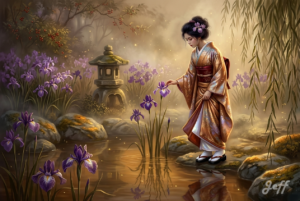
Une geisha classique se tient debout au bord d’une mare de jardin zen, entourée d’iris kakitsubata violets en pleine floraison émergeant de la brume dorée. Son kimono or et céladon se fond dans les reflets de l’eau calme — contemplation absolue dans la lumière tamisée du Taishō.
A classic geisha stands at the edge of a Zen garden pond, surrounded by violet kakitsubata irises in full bloom emerging from golden mist. Her gold and celadon kimono blends into the calm water reflections — absolute contemplation in Taishō twilight.
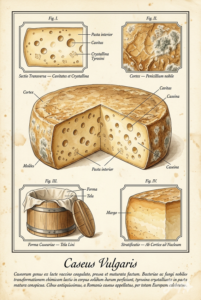
Une meule de fromage affiné en coupe centrale sur vélin crème, entourée de quatre vignettes : section transversale avec œils et cristaux de tyrosine, détail de la croûte et du Penicillium, le moule en bois cerclé de toile de lin, stratification croûte-à-cœur en lavis sépia.
A wheel of aged cheese in central cross-section on cream vellum, surrounded by four vignettes: internal structure with eyes and tyrosine crystals, rind detail with Penicillium, the wooden mould lined with linen cloth, crust-to-core stratification in sepia wash.