Anatomie
Anatomie : L’anatomie est la science qui décrit la forme et la structure des organismes vivants et les rapports des organes et tissus qui les constituent. On peut notamment distinguer l’anatomie animale (et en particulier l’anatomie humaine, très importante en médecine) et l’anatomie végétale (branche de la botanique).
Le mot est emprunté au bas latin anatomia, « dissection », issu du grec ancien de même sens ἀνατομή / anatomế, lequel provient du verbe ἀνατέμνω / anatémnō, « ouvrir en coupant » (de ἀνά / aná, « en remontant », et τέμνω / témnō, « couper »). Anatomie sur Wikipédia (fr) – Anatomy : Anatomy (from Ancient Greek ἀνατομή (anatomḗ) ‘dissection’) is the branch of morphology concerned with the study of the internal and external structure of organisms and their parts. Anatomy is a branch of natural science that deals with the structural organization of living things. It is an old science, having its beginnings in prehistoric times.
Anatomy is inherently tied to developmental biology, embryology, comparative anatomy, evolutionary biology, and phylogeny, as these are the processes by which anatomy is generated, both over immediate and long-term timescales. Anatomy and physiology, which study the structure and function of organisms and their parts respectively, make a natural pair of related disciplines, and are often studied together. Human anatomy is one of the essential basic sciences that are applied in medicine, and is often studied alongside physiology.
Anatomy is a complex and dynamic field that is constantly evolving as discoveries are made. In recent years, there has been a significant increase in the use of advanced imaging techniques, such as MRI and CT scans, which allow for more detailed and accurate visualizations of the body’s structures.
The discipline of anatomy is divided into macroscopic and microscopic parts. Macroscopic anatomy, or gross anatomy, is the examination of an animal’s body parts using unaided eyesight. Gross anatomy also includes the branch of superficial anatomy. Microscopic anatomy involves the use of optical instruments in the study of the tissues of various structures, known as histology, and also in the study of cells.
The history of anatomy is characterized by a progressive understanding of the functions of the organs and structures of the human body. Methods have also improved dramatically, advancing from the examination of animals by dissection of carcasses and cadavers (corpses) to 20th-century medical imaging techniques, including X-ray, ultrasound, and magnetic resonance imaging. Anatomy sur Wikipédia (en)
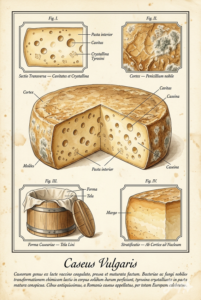
Une meule de fromage affiné en coupe centrale sur vélin crème, entourée de quatre vignettes : section transversale avec œils et cristaux de tyrosine, détail de la croûte et du Penicillium, le moule en bois cerclé de toile de lin, stratification croûte-à-cœur en lavis sépia.
A wheel of aged cheese in central cross-section on cream vellum, surrounded by four vignettes: internal structure with eyes and tyrosine crystals, rind detail with Penicillium, the wooden mould lined with linen cloth, crust-to-core stratification in sepia wash.