Medieval
Middle Ages : In the history of Europe, the Middle Ages or medieval period lasted approximately from the 5th to late 15th centuries, comparable with the post-classical period of global history. The medieval period is the middle epoch of the three traditional divisions of Western history: classical antiquity, the medieval period, and the modern period. The medieval period is itself subdivided into the Early, High, and Late Middle Ages.
The Middle Ages began with the fall of the Western Roman Empire and transitioned into the Modern age during the Renaissance, the Reformation, the European wars of religion, and the Age of Discovery. Early Modernity is a single term adopted to describe this end-stage of the period, during which medieval Europes shades into the modern period.
Population decline, counterurbanisation, the collapse of centralised authority, invasions, and mass migrations of tribes had begun in late antiquity (c. ~3rd–8th centuries) and lasted into the Early Middle Ages (c. 5th–10th centuries). The large-scale movements of the Migration Period, including various Germanic peoples, formed new kingdoms in what remained of the Western Roman Empire. In the 7th century, North Africa and the Middle East—once part of the Byzantine Empire—came under the rule of the Umayyad Caliphate, an Islamic empire, after conquest by Muhammad’s successors. Although there were substantial changes in society and political structures, the break with classical antiquity was incomplete. The still-sizeable Byzantine Empire, Rome’s direct continuation, survived in the Eastern Mediterranean and remained a major power. The empire’s law code, the Corpus Juris Civilis or « Code of Justinian », was rediscovered in Northern Italy in the 11th century. In the West, most kingdoms incorporated the few extant Roman institutions. Monasteries were founded as campaigns to Christianise the remaining pagans across Europe continued. The Franks, under the Carolingian dynasty, briefly established the Carolingian Empire during the later 8th and early 9th centuries. It covered much of Western Europe but later succumbed to the pressures of internal civil wars combined with external invasions: Vikings from the north, Magyars from the east, and Saracens from the south.
During the High Middle Ages, which began after 1000, the population of Europe increased significantly as technological and agricultural innovations allowed trade to flourish and the Medieval Warm Period climate change allowed crop yields to increase. Manorialism, the organisation of peasants into villages that owed rent and labour services to the nobles, and feudalism, the political structure whereby knights and lower-status nobles owed military service to their overlords in return for the right to rent from lands and manors, were two of the ways society was organised in the High Middle Ages. This period also saw the collapse of the unified Christian church with the East–West Schism of 1054. The Crusades, first preached in 1095, were military attempts by Western European Christians to regain control of the Holy Land from Muslims. Kings became the heads of centralised nation-states, reducing crime and violence but making the ideal of a unified Christendom more distant. Intellectual life was marked by scholasticism, a philosophy that emphasised joining faith to reason, and by the founding of universities. The theology of Thomas Aquinas, the paintings of Giotto, the poetry of Dante and Chaucer, the travels of Marco Polo, and the Gothic architecture of cathedrals such as Chartres are among the outstanding achievements toward the end of this period and into the Late Middle Ages.
The Late Middle Ages was marked by difficulties and calamities, including famine, plague, and war, which significantly diminished the population of Europe; between 1347 and 1350, the Black Death killed about a third of Europeans. Controversy, heresy, and the Western Schism within the Catholic Church paralleled the interstate conflict, civil strife, and peasant revolts that occurred in the kingdoms. Cultural and technological developments transformed European society, concluding the Late Middle Ages and beginning the early modern period. Middle Ages sur Wikipédia (en)
Moyen Âge : Le Moyen Âge est une période de l’histoire de l’Europe, s’étendant du début du Ve à la fin du XVe siècle, qui débute avec le déclin de l’Empire romain d’Occident et se termine par la Renaissance et les grandes découvertes. Située entre l’Antiquité et les Temps modernes, la période est souvent subdivisée entre le haut Moyen Âge (Ve – Xe siècle), le Moyen Âge central (XIe – XIIIe siècle) et le Moyen Âge tardif (XIVe – XVe siècle).
La dépopulation, la désurbanisation et les migrations de l’Antiquité tardive se poursuivent durant le haut Moyen Âge et les envahisseurs ou migrants barbares fondent de nouveaux royaumes sur les territoires de l’ancien Empire romain d’Occident. La période est marquée par de profonds changements sociétaux et politiques ; la rupture avec l’Antiquité classique n’est cependant pas complète. La partie orientale de l’Empire romain survit aux bouleversements géopolitiques de la période et reste une puissance de premier plan sous le nom d’Empire byzantin. Il perd cependant une grande partie de ses territoires au Moyen-Orient et en Afrique du Nord au profit des califats musulmans au VIIe siècle. À l’ouest, la plupart des royaumes incorporèrent de nombreuses institutions romaines, tandis que l’expansion du christianisme fut marquée par la construction de nombreux monastères. Sous la dynastie carolingienne, les Francs établissent un empire couvrant la plus grande partie de l’Occident chrétien au IXe siècle avant de décliner du fait des tensions internes et des attaques Vikings au nord, hongroises à l’est et sarrasines au sud.
Après l’an mille, durant le Moyen Âge central, la population européenne augmente fortement grâce à des innovations techniques, qui permettent un accroissement des rendements agricoles. La société se réorganise selon les systèmes de la seigneurie, l’organisation des paysans en communautés cultivant la terre pour le compte des nobles, et de la féodalité, la structure politique par laquelle les chevaliers et la basse-noblesse servaient dans l’armée de leur suzerain en échange du droit d’exploiter leurs fiefs. Cette dernière institution connaît un déclin à la fin du Moyen Âge du fait des efforts de centralisation menés par les différents souverains dont l’autorité se renforce aux dépens de celle des seigneurs locaux. Les croisades, lancées pour la première fois au XIe siècle sont des expéditions militaires menées au nom de la foi catholique ; elles sont principalement destinées à reprendre le contrôle de la Terre sainte aux musulmans, mais visent également les croyances jugées hérétiques en Europe. La vie intellectuelle est marquée par la scolastique cherchant à concilier la foi et la raison et par l’apparition d’universités dans les grandes villes. La philosophie de Thomas d’Aquin, les peintures de Giotto, la poésie de Dante et de Chaucer, les récits de Marco Polo et l’architecture des grandes cathédrales gothiques comme celle de Chartres sont parmi les plus grandes réalisations de cette période.
Le Moyen Âge tardif est marqué par des famines, la peste noire et les guerres qui réduisent fortement la population de l’Europe occidentale tandis que l’Église catholique traverse de profondes crises politiques. Les changements culturels et technologiques de la période transforment néanmoins la société européenne et ouvrent la voie à la Renaissance et à l’époque moderne. Moyen Âge sur Wikipédia (fr)
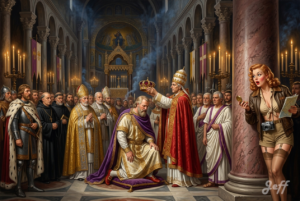
Le 25 décembre 800, dans la basilique Saint-Pierre de Rome, le pape Léon III pose la couronne impériale sur la tête de Charlemagne — ressuscitant l’Empire romain d’Occident et fondant l’idée même de l’Europe chrétienne médiévale.
On Christmas Day 800, Pope Leo III crowns Charlemagne Emperor of the Romans in Saint Peter’s Basilica — resurrecting the ghost of the Western Roman Empire and laying the cornerstone of medieval Christian Europe.