Carolingian
Carolingiens : Les Carolingiens (ou Carlovingiens jusqu’à la fin du XIXe siècle) forment une dynastie de rois francs qui règnent sur l’Europe occidentale du VIIIe siècle au Xe siècle.
Le terme carolingien, en latin médiéval karolingi, est dérivé de Carolus, qui est à la fois le nom latin de Charles Martel (Carolus Martellus), l’aïeul de cette dynastie, et celui de son petit-fils Charlemagne (Carolus Magnus), considéré comme le plus illustre des rois de cette lignée.
Les Carolingiens sont désignés par la chancellerie de France et certains historiens comme la « deuxième race » des rois de France, succédant à la dynastie des Mérovingiens. Carolingiens sur Wikipédia (fr) – Carolingian dynasty : The Carolingian dynasty ( KARR-ə-LIN-jee-ən; known variously as the Carlovingians, Carolingi, Carolings, Karolinger or Karlings) was a Frankish noble family named after Charles Martel and his grandson Charlemagne, descendants of the Arnulfing and Pippinid clans of the 7th century AD. The dynasty consolidated its power in the 8th century, eventually making the offices of mayor of the palace and dux et princeps Francorum hereditary, and becoming the de facto rulers of the Franks as the real powers behind the Merovingian throne. In 751 the Merovingian dynasty which had ruled the Franks was overthrown with the consent of the Papacy and the aristocracy, and Pepin the Short, son of Martel, was crowned king of the Franks. The Carolingian dynasty reached its peak in 800 with the crowning of Charlemagne as the first emperor of the Romans in the West in over three centuries. Charlemagne’s death in 814 began an extended period of fragmentation of the Carolingian Empire and decline that would eventually lead to the evolution of the Kingdom of France and the Holy Roman Empire. Carolingian dynasty sur Wikipédia (en)
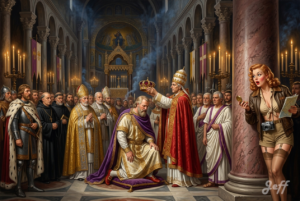
Le 25 décembre 800, dans la basilique Saint-Pierre de Rome, le pape Léon III pose la couronne impériale sur la tête de Charlemagne — ressuscitant l’Empire romain d’Occident et fondant l’idée même de l’Europe chrétienne médiévale.
On Christmas Day 800, Pope Leo III crowns Charlemagne Emperor of the Romans in Saint Peter’s Basilica — resurrecting the ghost of the Western Roman Empire and laying the cornerstone of medieval Christian Europe.