absolute silence
Silence : Silence is the absence of ambient audible sound, the emission of sounds of such low intensity that they do not draw attention to themselves, or the state of having ceased to produce sounds; this latter sense can be extended to apply to the cessation or absence of any form of communication, whether through speech or other medium. Remaining mute can be a symptom of mental illness.
Sometimes speakers fall silent when they hesitate in searching for a word, or interrupt themselves before correcting themselves. Discourse analysis shows that people use brief silences to mark the boundaries of prosodic units, in turn-taking, or as reactive tokens, for example, as a sign of displeasure, disagreement, embarrassment, desire to think, confusion, and the like. Relatively prolonged intervals of silence can be used in rituals; in some religious disciplines, people maintain silence for protracted periods, or even for the rest of their lives, as an ascetic means of spiritual transformation. Silence sur Wikipédia (en)
Silence : Le silence est, dans son sens originel, l’état de la personne qui s’abstient de parler. Dans son sens actuellement le plus courant, c’est l’absence de bruit, c’est-à-dire de sons indésirables. Le silence absolu serait l’absence, impossible, de tout son audible.
Par extension, le silence désigne aussi l’absence de l’expression écrite. Le bruit s’associe au désordre et à l’agitation, le silence, au calme et à la tranquillité.
En solfège, les silences sont les signes qui indiquent un arrêt de la production de sons musicaux pendant une durée spécifiée. Silence sur Wikipédia (fr)
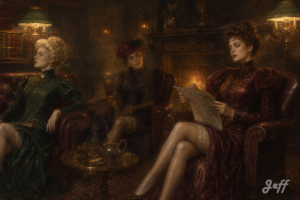
Dans le salon feutré du Club Diogène de Pall Mall — sa version secrète et non mixte —, trois membres anonymes observent le silence absolu prescrit par le règlement : l’une tourne les pages d’un Times plié avec une précision chirurgicale, une autre fixe la cheminée depuis son fauteuil en cuir bordeaux avec une sérénité marmoréenne, la troisième lève imperceptiblement un sourcil vers sa voisine — transgression minuscule, scandale immense. Pas de Holmes. Pas de Watson. Juste le silence, et les femmes qui le possèdent.
In the hushed salon of Pall Mall’s Diogenes Club — its secret, unmixed version — three anonymous members observe the absolute silence prescribed by rule: one turns the pages of a folded Times with surgical precision, another fixes the fireplace from her burgundy leather armchair with marble serenity, a third raises an imperceptible eyebrow toward her neighbour — the smallest transgression, the most enormous scandal. No Holmes. No Watson. Only silence, and the women who own it.